
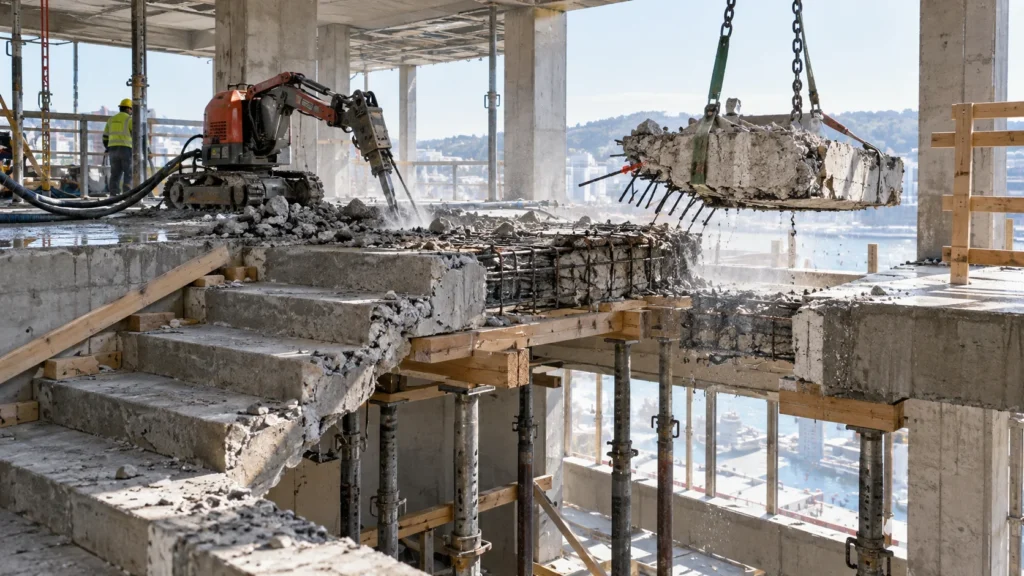
Concrete demolition can look straightforward until the section you want to remove turns out to support something you need to keep. A wall opening, a damaged slab, or an old stair can all affect nearby concrete and connected parts of a building. Planning the work means identifying those connections before choosing where to cut, break, or lift.
Define What Stays Before Deciding What Goes
Start with a clear boundary between the concrete to be removed and the structure to remain. Mark the proposed demolition area on a drawing if one is available, then compare it with what is visible on site. Note adjoining walls, columns, beams, floors, and foundations. A surface line alone does not show how those parts work together.
Existing drawings can help, but conditions may differ from what they show. Alterations made over the years may have changed openings or added supports. If the work involves a potentially load-bearing element, have a qualified structural professional assess it before demolition begins. They can determine whether the proposed removal is feasible and whether temporary support or a different sequence is needed.
For example, creating a doorway in a concrete wall is more than removing a rectangle. The question is what the wall carries above the opening and how that load will be supported afterward. Resolving that question first allows the opening and demolition method to be planned around the structure.
Investigate What Is Inside and Around the Concrete
Concrete may contain reinforcement, embedded services, or connections to adjacent elements. Pipes and cables can also run close to the intended work area. Review available records, inspect accessible surfaces, and use suitable locating methods where concealed items are a concern. Treat uncertain findings as a reason to investigate further, especially before making a deep cut.
Look beyond the immediate removal area. Vibration and movement can affect nearby finishes, masonry, and weakened concrete. Check for existing cracks or signs of movement, and record their locations before work starts. That gives the team a useful reference if a change appears during demolition.
Access matters too. A method that works in an open yard may be difficult inside an occupied building. Check how workers and equipment will reach the area, where removed pieces will go, and whether the surrounding floor can carry equipment and debris. Keep people who do not need access away from the work area.
Match the Method to the Structure
Selective demolition removes only the intended section while protecting what remains. It often combines precise cuts with controlled breaking and removal. The best mix depends on the concrete’s thickness, reinforcement, location, and the size of pieces that can be handled safely.
Concrete sawing can establish a defined edge for an opening or separate a section from surrounding material. Core drilling can form round openings or help establish points for a planned cut. Breaking or chiselling can then remove material where appropriate. Each approach has limits: cutting still requires a plan for the separated piece, while aggressive breaking can transfer force into nearby concrete.
Consider a slab section being removed beside an existing wall. Cutting a boundary may help keep the removal within the planned area, but the team must also decide how to support and remove the slab pieces. Letting a heavy piece drop or levering against the wall could damage the very structure the cut was meant to protect.
Plan the Sequence, Support, and Removal Route
The order of work is as important as the tool. Identify when a piece will lose support and what will hold it at that moment. Where the structure needs temporary support, its arrangement and removal should follow a suitable structural plan. Do not rely on an adjoining element to carry a load that has not been assessed.
Break the job into manageable stages:
- Confirm the removal limits. Mark the area and check the markings against the agreed plan.
- Locate likely obstructions. Resolve uncertainties about reinforcement, services, and hidden connections before cutting deeply.
- Provide required support and protection. Prepare adjacent surfaces, access routes, and any temporary works specified for the job.
- Separate and remove sections in a planned order. Control each piece as it comes free, and keep debris from building up where it creates an added load or obstruction.
- Inspect the remaining structure. Pause if unexpected cracking, movement, or concealed conditions appear.
This sequence may change once concrete is opened. That is a reason to keep decisions with the people responsible for the work, rather than pressing ahead when site conditions contradict the plan.
Allow for Dust, Noise, Water, and Vibration
Structural damage is the main concern, but the work environment shapes the demolition plan. Cutting and breaking can produce dust and noise; some cutting methods also use water. Decide how these will be controlled and where water and slurry can drain or be collected. Protect nearby rooms, equipment, and finishes as the setting requires.
Vibration deserves particular attention around fragile finishes or already damaged construction. More force is not necessarily faster once repairs to surrounding areas are considered. In a confined or sensitive location, smaller sections and a more controlled pace may make the work easier to manage, although they can require more handling and setup.
For more detailed information on this topic, read our guide on How Wire Sawing Handles Thick Concrete Structures.
Leave the Remaining Concrete Ready for Its Next Use
Demolition is complete only when the structure left behind has been checked against the intended result. Inspect cut edges and nearby surfaces for unintended damage. Confirm that exposed reinforcement, openings, and rough surfaces are addressed as required by the next stage of construction. Keep the area clear enough for that inspection to be meaningful.
The central planning question is simple: what happens to the rest of the structure when this concrete is removed? Define the boundary, investigate hidden conditions, choose a controlled method, and plan each piece’s removal. When the answer is uncertain, resolve it before demolition reaches the point where the concrete can no longer be put back.