
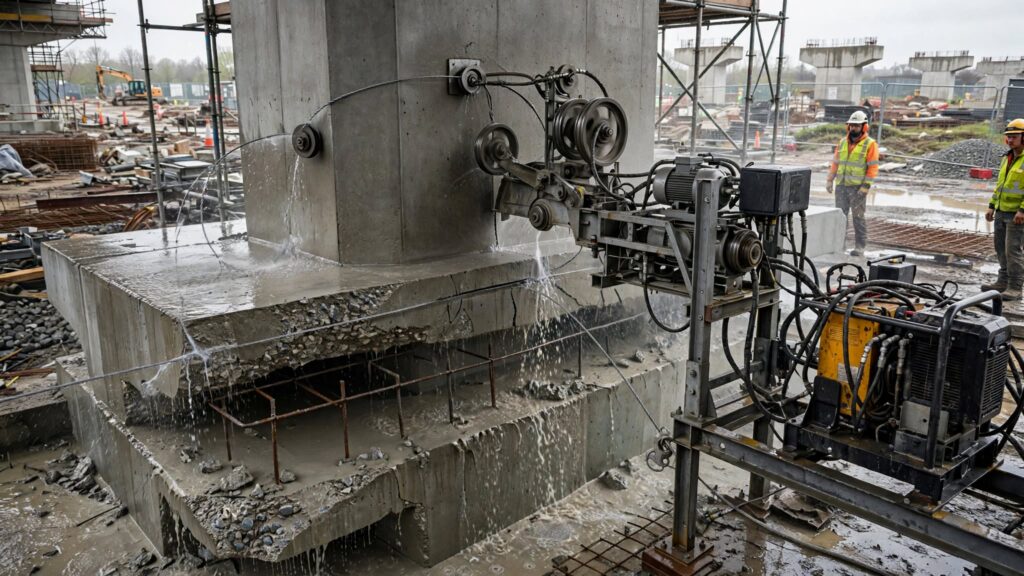
Thick concrete creates a different set of challenges from ordinary slabs, walls, and smaller structural elements. When concrete sections are unusually deep, heavily reinforced, awkwardly shaped, or difficult to reach with conventional cutting equipment, wire sawing can provide a practical way to make controlled cuts.
Wire sawing uses a diamond-embedded wire that travels continuously around the concrete being cut. Instead of depending on the diameter of a circular saw blade, the wire can be arranged around much larger structural sections. This makes wire sawing particularly useful for substantial concrete foundations, columns, bridge components, retaining structures, and other heavy construction elements.
What Is Concrete Wire Sawing?
Concrete wire sawing is a cutting method that uses a flexible diamond wire guided around or through a concrete structure. The wire moves continuously while the diamond segments gradually cut through the material.
A system normally includes the diamond wire, drive equipment, guide pulleys, and a controlled water supply. The pulleys establish the cutting path and help keep the wire positioned correctly as it passes through the concrete.
Because the cutting element is flexible, it is not restricted to the cutting depth of a conventional circular blade. This characteristic is one of the main reasons wire sawing is considered for thick or oversized concrete sections.
Why Thick Concrete Requires a Different Cutting Approach
Standard concrete saws work well for many construction and renovation tasks, but their cutting depth is limited by blade size and equipment configuration. Increasing structural thickness can make it difficult or impractical to complete a cut from one side.
This issue becomes more complicated when reinforcing steel runs through the concrete. Large foundations, structural walls, machine bases, and infrastructure components may contain substantial reinforcement that must be cut along with the surrounding concrete.
Readers looking at the wider role of cutting methods in renovation may also find Concrete Sawing Explained: When It’s the Best Choice for Renovation Projects useful for understanding where concrete cutting fits into alteration and removal work.
Wire sawing approaches the problem differently. Rather than forcing a rigid blade deeper into the structure, the wire follows a planned path through the entire section.
How the Wire Sawing Process Works
Planning the Cut
Before cutting starts, the structure and intended opening need to be assessed. The cutting line must account for structural conditions, nearby utilities, reinforcement, access, and how the separated concrete section will be supported and removed.
This planning is particularly important with thick concrete because the resulting sections can be large and difficult to handle.
Positioning the Diamond Wire
The wire is routed around the concrete using guide pulleys. Depending on the structure, access holes may be needed so the wire can pass through or around the section and form the required cutting loop.
Correct pulley placement helps establish the direction of the cut and keeps the wire moving along the intended path.
Cutting Through Concrete and Reinforcement
Once the system is operating, the diamond wire moves continuously against the concrete. The cutting action gradually works through the material and can continue through embedded reinforcing steel encountered along the cutting path.
Water is commonly used during the process to cool the cutting components and help manage concrete slurry and airborne dust.
Where Wire Sawing Is Commonly Useful
Wire sawing is generally considered when the dimensions or configuration of a structure make conventional sawing difficult. Typical applications can include thick foundations, concrete columns, bridge elements, heavily reinforced walls, large beams, and substantial equipment bases.
It can also be useful during selective demolition. For example, a project may require one section of a large concrete structure to be separated while adjacent areas remain in place. A carefully planned wire cut can divide the required section into manageable pieces for controlled removal.
Another application involves structures with unusual shapes. Since the wire can be guided using pulleys, the equipment can be configured around components that would be difficult to approach with a large rigid blade.
Benefits of Wire Sawing for Heavy Concrete
One important advantage is its ability to accommodate substantial cutting depths. The technique can be configured according to the dimensions of the structure rather than relying solely on blade diameter.
The relatively narrow cutting path is another practical characteristic. When the goal is to separate a defined section, limiting unnecessary material removal can make subsequent work easier.
Wire sawing also gives contractors flexibility when working around challenging geometry. Pulley arrangements can help establish cutting paths where direct saw access is restricted.
Because the process can cut concrete and embedded reinforcement together, it is suited to reinforced structural elements where steel bars would otherwise complicate removal.
Limitations and Project Considerations
Wire sawing is not automatically the right method for every concrete cutting job. Smaller slabs, standard wall openings, and shallow cuts may be handled more simply with other sawing techniques.
Access is also important. There must be enough room to install the wire, pulleys, drive equipment, and supporting systems. The separated concrete needs a removal plan as well. Completing the cut is only part of the operation, especially when large structural sections are involved.
Water and slurry management should be considered before work begins. Interior projects or occupied buildings may require additional measures to contain water and debris.
Structural conditions matter just as much as equipment selection. Removing or separating load-bearing concrete without appropriate planning can affect surrounding elements, so the cutting sequence and temporary support requirements need to be established before work proceeds.
Choosing Wire Sawing for a Concrete Project
The decision usually comes down to concrete thickness, reinforcement, access, structural geometry, and the required cut. If a conventional saw can comfortably reach the full cutting depth, wire sawing may not be necessary. When blade depth or equipment access becomes a major limitation, however, a diamond wire system can provide another way to approach the structure.
The complete operation should also be considered, including preparation, cutting, support, lifting, removal, and slurry control. Looking at these factors together helps determine whether wire sawing fits the actual site conditions rather than choosing a method based only on concrete thickness.
Conclusion
Wire sawing addresses one of the main difficulties of working with thick concrete: making a controlled cut through a structural section that may be too deep or complex for conventional blade-based equipment. Its flexible diamond wire can be configured around large, reinforced, and unusually shaped concrete elements.
Successful wire sawing still depends on careful planning. Access, structural support, reinforcement, water management, and removal of the separated concrete all influence how the work should be organized. When those factors are properly evaluated, wire sawing can be a practical technique for demanding concrete alteration and selective demolition projects.